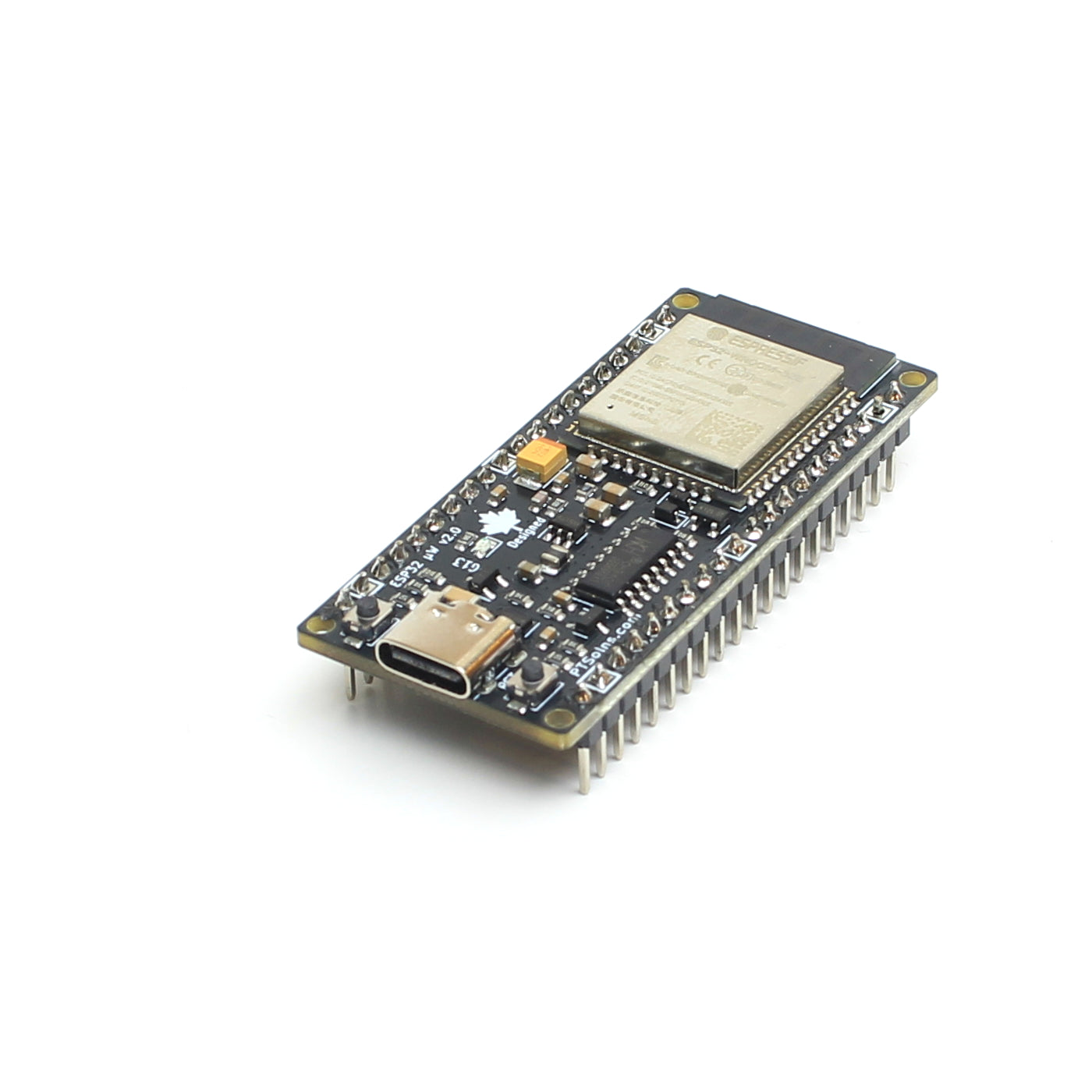


If you've ever searched for "What's the best microcontroller?" you've probably been overwhelmed by hundreds of opinions. One person recommends an ESP32. Another swears by STM32. Someone else insists the Uno is all you'll ever need.
The truth is there isn't a single "best" microcontroller.
After designing commercial development boards, educational products, wireless IoT devices, battery powered systems, and countless prototypes over the years, I've learned that selecting the right microcontroller has very little to do with buying the most powerful processor available.
Instead, it's about choosing the simplest microcontroller that comfortably meets your project requirements while allowing you to build your project efficiently.
Here's the process I use whenever I start a new embedded project.
Don't Start with CPU Speed
One of the biggest mistakes beginners make is comparing clock speeds, RAM, or Flash memory before anything else.
A 240 MHz processor isn't automatically better than an 8 MHz processor.
In fact, one of the projects I'm currently developing is a small drone powered by a Nano Flip 3V3, an ATmega328P based development board running at just 8 MHz.
On paper, that sounds tiny compared to today's dual core ESP32 processors or Cortex M7 devices.
In practice?
It's doing exactly what I need.
Because the microcontroller satisfies the project's requirements, choosing something larger would simply add complexity without providing any meaningful benefit.
Choose the processor your project needs, not the one with the biggest numbers.
Step 1: List the Peripherals Your Project Needs
The first thing I look at is not processing power.
It's peripherals.
Ask yourself questions like:
-
Do I need I2C?
-
Do I need SPI?
-
How many UARTs are required?
-
Will I need WiFi or Bluetooth?
-
Do I need CAN Bus?
-
USB?
-
Ethernet?
-
PWM outputs?
-
ADC inputs?
-
Interrupt capable GPIO?
This step immediately eliminates many microcontrollers before you even compare performance.
For example, if your project requires built in WiFi, there's little point spending time evaluating microcontrollers that don't include it.
Likewise, if your design needs multiple SPI buses or a large number of PWM outputs, you'll want to verify those exist before looking at anything else.
Step 2: Make Sure It Physically Fits
The next consideration is the package or development board size.
If your project has strict space constraints, some otherwise excellent microcontrollers may simply be too large.
Small IoT devices, drones, wearable electronics, and handheld products often have very different size requirements than a desktop prototype.
There's no point choosing the perfect processor if it won't physically fit inside your enclosure.
Step 3: Check Availability
This step is surprisingly important.
Can you actually buy it?
I always check suppliers such as DigiKey and Amazon before committing to a microcontroller.
If a processor is difficult to source, constantly out of stock, or has extremely expensive shipping, it may not be worth using.
A slightly less capable microcontroller that you can purchase tomorrow is often a much better choice than a theoretically perfect processor that's unavailable.
Step 4: Consider the Entire Development Ecosystem
The microcontroller itself is only part of the equation.
What really determines how enjoyable a project is often comes down to the development ecosystem surrounding it.
When evaluating a microcontroller, I ask questions like:
- Is there good documentation?
- Are there example projects?
- Is there an active online community?
- Can I easily find libraries?
- Is there a development environment that supports it?
- Can I quickly get started without spending days configuring tools?
A processor with incredible specifications isn't much use if there are very few examples online or the development tools are difficult to use.
This is one of the reasons we developed the PTSolns IDE. It supports many of the most common microcontroller development boards while providing a simplified installation experience and integrated library management. Whether you're working with a classic ATmega328P based board or an ESP32, getting started is designed to be straightforward rather than frustrating.
Documentation is equally important. That's why every PTSolns development board includes comprehensive online documentation with detailed datasheets, wiring diagrams, pinouts, 3D models, Fritzing files, example code, and getting started guides. Good documentation often saves far more time than choosing a microcontroller with slightly higher specifications.
If two microcontrollers offer similar features and cost roughly the same, I'll almost always choose the one with the stronger ecosystem. Better documentation, better software support, and better examples usually lead to a faster and more enjoyable development experience.
Step 5: Don't Forget Voltage Compatibility
Another mistake I regularly see is ignoring voltage requirements.
Not all microcontrollers operate at the same logic levels.
Some use 3.3 V logic.
Others use 5 V.
Your sensors, displays, communication modules, and other peripherals must all be compatible.
If they aren't, you'll likely need additional hardware such as logic level shifters, increasing both cost and complexity.
You should also verify the input voltage requirements.
Applying voltages outside the recommended operating range can permanently damage the microcontroller.
Step 6: Learn from Real World Mistakes
I've certainly made mistakes selecting microcontrollers.
One project required high precision analog measurements.
I chose a generic ESP32 development board because it seemed like the obvious choice.
Unfortunately, the onboard ADC didn't provide the accuracy or resolution my application required.
Rather than replacing the entire processor, I ended up adding an external ADC to solve the problem.
That experience reinforced an important lesson.
Your peripherals are often more important than your CPU.
A faster processor doesn't compensate for missing hardware features.
Step 7: Reuse What Already Works
This is something professional engineers do all the time.
If I already have a proven circuit, tested firmware, and working PCB design, I'll often reuse those building blocks instead of starting from scratch.
Doing so dramatically reduces development time.
It also reduces debugging, validation, testing, and manufacturing risk.
Many engineers spend weeks searching for the "perfect" microcontroller when they already have a perfectly suitable design sitting in another project.
Reuse isn't laziness.
It's good engineering.
Which Microcontroller Do I Recommend?
There isn't one answer for every application, but these are the platforms I most commonly recommend.
For Beginners and Home Automation
The ESP32 microWatt is my first recommendation.
It combines WiFi and Bluetooth on a single platform while maintaining very low power consumption, making it ideal for battery powered IoT projects.
There is also an enormous amount of online documentation, tutorials, libraries, and community support, allowing beginners to get started quickly.
For Learning Embedded Systems
If your goal is education rather than building connected devices, it's difficult to beat an Uno compatible board, such as the Uno R3+, with the extra features.
The Arduino ecosystem has existed for many years and offers thousands of tutorials, shields, example projects, and educational resources.
Rather than fighting your development tools, you can focus on learning electronics and programming fundamentals.
My Microcontroller Selection Checklist
Whenever I begin a new project, I ask these questions in roughly this order.
-
Does it have every peripheral my project requires?
-
Does it have enough GPIO pins?
-
Will it physically fit?
-
Is it readily available?
-
Is there good documentation and community support?
-
Is it compatible with my preferred development tools?
-
Does it match my project's voltage requirements?
-
Does it provide enough processing power?
-
Can I reuse an existing design instead?
Notice that processing power appears near the bottom of the list.
That's intentional.
Most projects don't need the fastest processor available.
They need the right processor.
Final Thoughts
If there's one lesson I've learned after years of embedded development, it's this:
The best microcontroller isn't the one with the highest clock speed or the largest memory.
It's the one that lets you successfully finish your project.
Choose a platform with the peripherals you need, the documentation you'll actually use, and an ecosystem that helps you move quickly.
More often than not, selecting a familiar, well supported microcontroller will produce a better result than chasing the latest high performance device.
Sometimes, the best engineering decision isn't choosing something new.
It's recognizing that the simplest solution is already good enough.
Cheers,
Mathias @ PTSolns