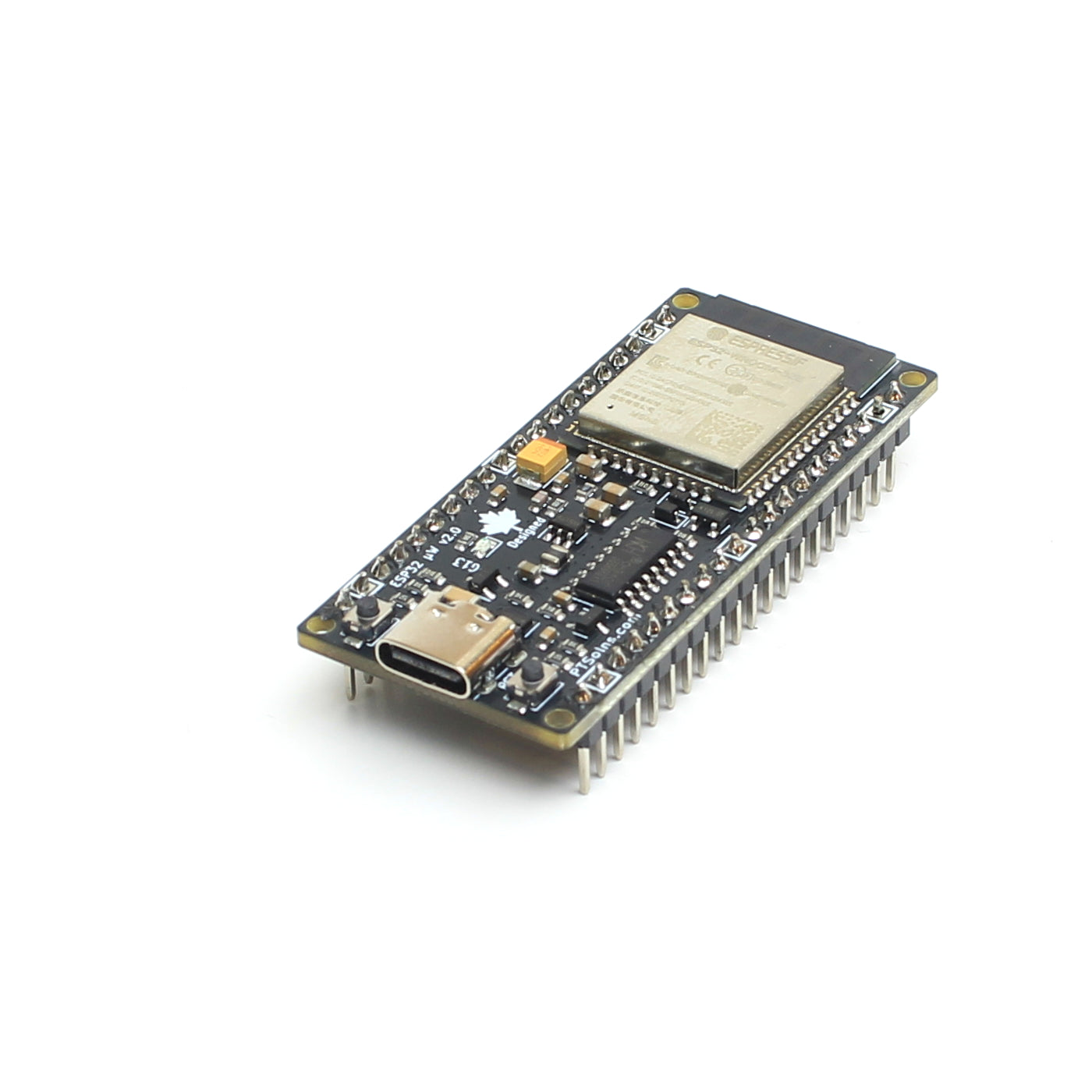



LoRa SX1276 915MHz Shield | Arduino UNO & LoRaWAN Compatible
LoRa SX1276 915MHz Shield | Arduino UNO & LoRaWAN Compatible
Couldn't load pickup availability
NOTE: For large quantity orders of the LoRa® SX1276 915MHz Shield with custom pricing please contact us directly.
This product has a datasheet!
This product has a 3D model!
This product has tutorials:
Node-to-Node LoRa Network (TTB #27)
Node-to-Gateway LoRa Network (TTB #28)
Also available on
About LoRa SX1276 915MHz Shield
- Plug & Play Ready: The PTSolns LoRa® SX1276 915MHz Shield is fully assembled and ready to use right out of the box. All logic level shifting and hardware configuration are handled onboard, making this shield an excellent entry point for anyone wanting to learn about the world of LoRa. Connect the LoRa Shield to a gateway and push data to the cloud, or use two or more LoRa Shields to create a node-to-node direct wireless communication network. The applications are endless.
- Packed with Features: The LoRa Shield includes the popular and easy to use AHT20 temperature and humidity sensor, allowing you to use the shield right out of the box to send sensor data. Connecting additional modules and sensors is easy using the onboard QWIIC® connector. Simply plug in a sensor and transmit the data. We have developed a getting started sketch to help you get up and running quickly. It is available in the PTSolns Documentation Repository.
- LoRaWAN Compatible: The PTSolns LoRa SX1276 915MHz Shield for Uno is tested and verified to be LoRaWAN compatible. A complete tutorial is included showing how to push temperature and humidity data from the LoRa Shield to a nearby gateway and onward to The Things Network (TTN) Cloud. Full setup details are available in the PTSolns Documentation Repository.
- What's Included: Each package includes one (1) PTSolns LoRa SX1276 915MHz Shield (fully assembled) and one (1) 915MHz antenna. Uno microcontroller development board not included. Soldering is not required.
- Customer Support & Resources: We’re here to help. Contact PTSolns support for assistance or technical questions. Every PTSolns product is backed by our comprehensive resource library, including datasheets, schematics, 3D models, Fritzing files, and tutorials. All supporting material is freely available on our PTSolns Documentation Repository.


Product Description

The PTSolns LoRa® SX1276 915MHz Shield is designed as a practical platform for developing and testing long-range wireless and LoRaWAN-based applications. It is LoRaWAN compatible and has been tested on The Things Industries cloud for reliable gateway and cloud connectivity. Please see our tutorial on this for specific and important details.
The shield includes an onboard AHT20 sensor for measuring temperature and humidity, allowing sensor data transmission without additional hardware. An onboard QWIIC connector is provided to simplify the connection of external modules and sensors.
All required logic level shifting is implemented on the board, and the shield is fully assembled and ready for use. Hardware configuration pins are accessible on the back of the board, and the onboard power LED can be disconnected via a rear jumper for reduced power consumption during testing.
The shield is compatible with the PTSolns Uno R3+, PTSolns DIY UNO Kit, the Uno R3, Uno R4, and other equivalent Uno microcontroller development boards. Full tutorials are available for getting started making a node-to-node wireless communication network, as well as LoRaWAN gateway connection. A complete datasheet and additional supporting material are available through the PTSolns Documentation Repository.
Shield-Series
This product is part of the Shield-Series. All the members of this series include:
- Proto-Shield
- NRF-Shield
- Interface-Shield
- RTC MicroSD Shield
- LoRa® SX1276 915MHz Shield (this product page)
Features of the LoRa SX1276 915MHz Shield
The following are highlights of the LoRa SX1276 915MHz Shield. For full details please see the datasheet which can be found in our PTSolns Documentation Repository.
- Compatibility: PTSolns Uno R3+, PTSolns DIY UNO Kit, Arduino R3, R4 Wifi, R4 Minima
- LoRa SX1276 915MHz module
- Shield is LoRaWAN compatible (see our Tutorial on this)
- Onboard AHT20 temperature and humidity sensor
- Onboard QWIIC connector
- Onboard Power LED (able to disconnect via jumper on back)
Hardware Pin Connections
The hardware pin connections made on the LoRa® SX1276 915MHz Shield are outlined in the tables below.
| LoRa SX1276 Pins | Development Board Pins | Notes |
| DIO0 | D2 | Closed jumper on back. Can disconnect by cutting jumper. |
| DIO1 | D3 | Closed jumper on back. Can disconnect by cutting jumper. |
| DIO2 | D4 | Closed jumper on back. Can disconnect by cutting jumper. |
| DIO3 | D5 | Closed jumper on back. Can disconnect by cutting jumper. |
| DIO4 | D6 | Closed jumper on back. Can disconnect by cutting jumper. |
| DIO5 | D7 | Closed jumper on back. Can disconnect by cutting jumper. |
| OE | ON / D8 | The logic level shifters are enabled by default (ON). If cutting the jumper trace on the back and connecting the jumper to “D8”, the LLS can be enabled/disabled by pin D8. Pull HIGH to enable. |
| NRESET | D9 | |
| NSS | D10 | |
| COPI | D11 | Formerly called “MOSI”. On the digital header (not ICSP header). |
| CIPO | D12 | Formerly called “MISO”. On the digital header (not ICSP header). |
| SCK | D13 | On the digital header (not ICSP header). |
| AHT20 Pins | Development Board Pins | Notes |
| SDA | A4 | On the digital header. |
| SCL | A5 | On the digital header. |
Range Test - How far can the LoRa Shield communicate?

Using the PTSolns LoRa SX1276 915MHz Shield we did a range test to see how far we could get reliable communication. Before proceeding, the user is asked to keep the following in mind:
- The transmitter hardware setup consisted of a PTSolns Uno R3+ stacked with the LoRa shield, and powered by a 5V battery pack. The receiver was similar, but it also included a display that printed out data received from the transmitter node.
- The test conditions were not ideal. The image above does not show the full distance, as that was too far to photograph. At the full distance there was quite a lot of interference (see "Fresnel zone"). Trees, electricity poles, and many other objects obstructed the Fresnel zone. Furthermore, the landscape was not fully flat as there were rolling hills all along. Not to mention Earth's curvature becomes a factor around 8-10km (depending on antenna height). Many online tutorials and blogs discuss very long ranges with SX1276 LoRa modules, but these are theoretical and do not reflect real-life settings. The goal of this range test was to show what is possible with this shield under a real-life scenario.
- We tested out in the country. Results will vary for users in urban settings where there are even more obstructions in the line-of-sight.
So how far did we get a reliable transmission reading? 6.15 km, or 3.82 miles! This is quite remarkable for an Uno shield under these real-life test settings! For a complete breakdown of this field test, including an analysis of Fresnel zone physics, RSSI, and SNR metrics, check out our TTB #29 blog article.
Node-to-Node LoRa Network
The LoRa® SX1276 915MHz Shield can be used to form a network in which the nodes (LoRa Shield + microcontroller + power source) communicate with each other.
Key Points:
- Communicate between two or more LoRa Nodes
- Private network (typically)
- No gateway required, can be set up anywhere
- No internet required, ideal for standalone projects

A full tutorial of this type of application using the LoRa® SX1276 915MHz Shield can be found here in TTB #27.
Node-to-Gateway LoRa Network
The LoRa® SX1276 915MHz Shield can be used to form a network in which the nodes (LoRa Shield + microcontroller + power source) communicate with a central gateway. The gateway typically is connected to the internet and the backend cloud.
Key Points:
- Communicate between LoRa Nodes and a gateway
- Private network / Public network
- Works with a single LoRa node, but requires a gateway nearby
- Connected to cloud, ideal for IoT projects

A full tutorial of this type of application using the LoRa® SX1276 915MHz Shield can be found here in TTB #28.
Other Names
- LoRa SX1276 915MHz Shield
- LoRa Shield
- 1276
- PTS-00207-201